Analysis
Article in question: https://www.nytimes.com/projects/2012/snow-fall/index.html#/?part=tunnel-creek

The story ‘Snowfall: The Avalanche at Tunnel Creek’ by John Branch is an interactive article telling the events of a snowstorm and avalanche that occurred in Washington USA in 2012. The article is comprised of a collection of scrolling single page sections on the New York Times website, six of them in total alongside additional tabs for maps of the location affected and another to detail those involved with the incident. Each chapter, or part, of the article focuses on a different part of the events that occurred, telling each part of the narrative piece-by-piece with different perspectives and information dotted within. Progressing onto each part as if you were moving from one chapter of a novel to the next.

The narrative is told as a blend between emotive description and re-enactment of events, to place the reader within the headspace and scenario of those who were directly affected by the avalanche as if it was being told as a novel rather than a news article. Following different ‘characters’ within the events to capture real, authentic experiences of the incident, engaging a reader as if this were a novel or fictitious story. Intercut in-between the stories of each person come logistical facts and direct information to provide the scope and realistic elements to remind the reader that this is indeed a retelling of a real event, as well as to shape the real scope and impact of all that occurred.
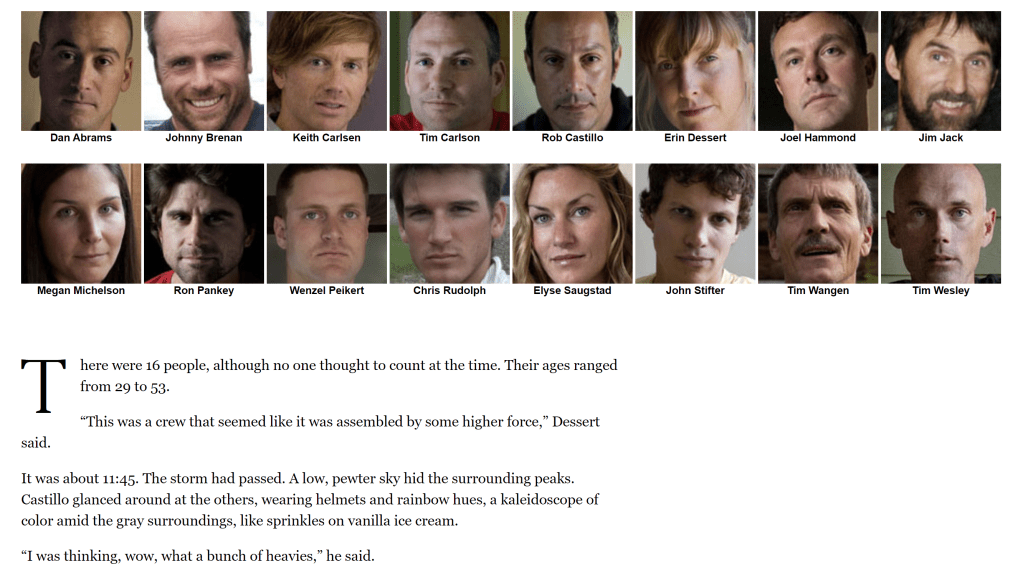
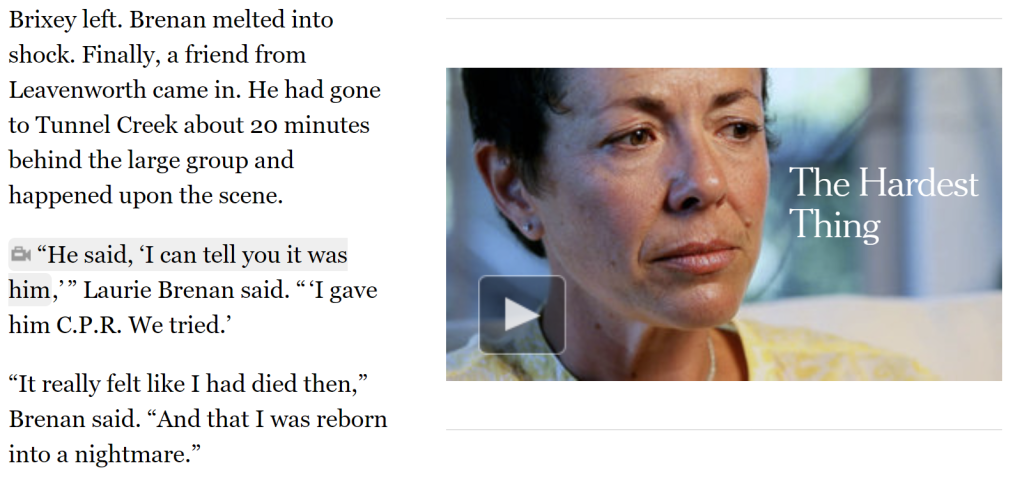
Throughout it as well, multimedia elements such as the looping video image as the banner of each part works to engage the viewer as if they were indeed reading a novel, while at the same time, real maps, simulations, images and sound clips of the avalanche, the area, the people involved and weather maps work to highlight the reality and the impact of the narrative being told.

All of this blends together to create an immersive and riveting retelling of the event, engaging a viewer as if it were a detailed and compelling fictional narrative while reinforcing the reality and the devastation of the real event.
 David Munro: Editor